


Hotcoin Research | The DeFi 0 Threshold Era Is Coming: Observations and Analysis of the Abstraction and Intention Tracks
Introduction
One of the recent hot topics in the cryptocurrency market is the rise of River, an abstract stablecoin protocol, following its strategic investment from TRON. On January 21, 2026, Sun Yuchen, founder of TRON, announced an $8 million investment in River to support the deployment of cross-chain stablecoin abstraction technology within the TRON ecosystem.
Following the announcement, River’s native token, RIVER, surged by nearly 1,900% over the past 30 days, rising from around $5 in early January to approximately $86, with a market capitalization exceeding $1.60 billion and ranking among the top 70 cryptocurrencies by market value. Industry figures such as Arthur Hayes and other prominent leaders have since publicly voiced support, further amplifying market attention. Meanwhile, multiple exchanges have listed RIVER in quick succession, triggering widespread discussion around the concept of “abstraction.”
In this article, we focus on two core concepts: abstraction and intention. We systematically analyze their development paths, current landscape, representative projects, and the risks and opportunities underlying these emerging tracks, while also exploring their future prospects.
The first section explains what “abstraction” and “intention” mean in the blockchain context and identifies the key challenges they aim to address. The second section reviews the broader development background and current state of related technical concepts — from the evolution of Ethereum account abstraction, to the maturation of the multi-chain ecosystem that has driven demand for chain abstraction, and finally to the emergence of the intention-based paradigm. The third section focuses on representative projects within the abstraction and intention tracks, analyzing their design patterns and practical implementations. The fourth section discusses the potential risks and challenges facing these narratives, while the final section explores their opportunities and long-term outlook.
Through this comprehensive analysis, we aim to provide investors and practitioners with actionable insights into how to identify opportunities within the abstraction and intention waves, remain alert to potential risks, and assess whether these innovative tracks can become a core engine for the next phase of industry growth.
I. Abstract and Intentional Concepts and Background Analysis
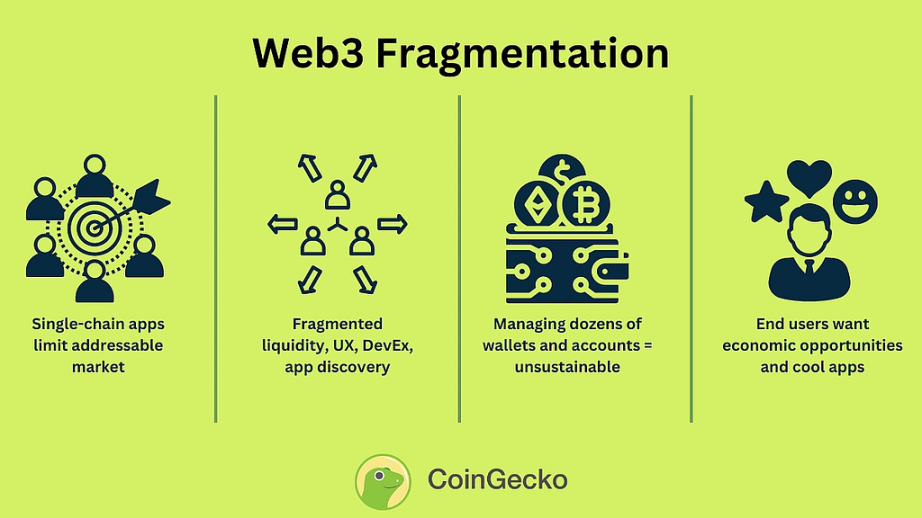
To understand “abstraction” and “intention,” it is first necessary to examine the pain points of the current blockchain user experience. For ordinary users, the threshold for using on-chain applications remains relatively high. Users must hold cryptocurrency, prepare the required assets on the target chain, maintain native tokens to pay network gas fees, and then navigate complex operations, including transaction signing, cross-chain bridging, and fee slippage. This multi-step process resembles a layer-by-layer barrier that prevents most Web2 users from entering Web3.
As a result, improving blockchain usability and reducing entry barriers for users have become widely shared objectives across the industry. Against this backdrop, the concepts of abstraction and intention emerged and are widely expected to significantly enhance the overall user experience.
Abstract (Abstraction)
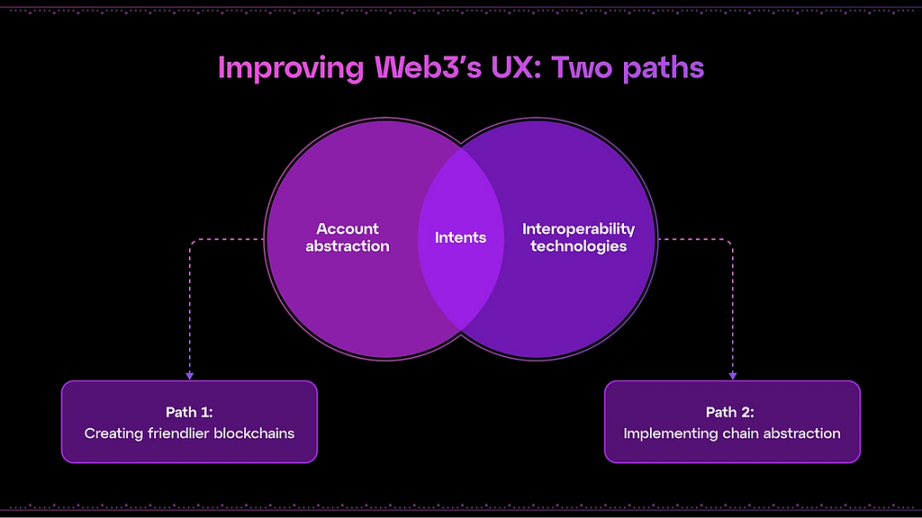
In the blockchain context, abstraction generally refers to a set of technical solutions designed to conceal underlying complexity and simplify user interactions across multiple chains. Depending on the application layer, abstraction can be broadly divided into two categories: account abstraction and chain abstraction. The current abstraction track primarily focuses on these two directions.
- Account abstraction represents a fundamental technical advancement that enables programmability of accounts. It enables advanced features such as social recovery, sponsored transactions (payments made on behalf of users), and batch execution, thereby making on-chain operations more flexible and user-friendly.
- Chain abstraction is more of a user-experience-level evolution. It arises as a natural response to the fragmentation of the multi-chain ecosystem, with the goal of eliminating the operational complexity associated with cross-chain interactions and allowing users to interact with multiple chains more seamlessly.
Intended (Intent)
While abstraction focuses on hiding complexity, the intent track is dedicated to redefining interaction logic. In traditional on-chain models, users must manually design and execute transaction workflows. For example, if a user wants to purchase SOL on Solana using USDC on the Ethereum mainnet, they must independently research bridge routes, select exchanges, and execute multiple transactions.
- Under an intent-based architecture, users only need to declare the desired end result — for example, “exchange 1,000 USDC on the Ethereum mainnet for SOL on the Solana network.” The system’s solver automatically identifies the optimal route and coordinates bridges and decentralized exchanges to complete the process.
- Instead of submitting explicit transaction instructions, users submit an “intent,” and the system executes actions based on that intent. This paradigm of “declaring outcomes, not processes” significantly reduces operational complexity and makes blockchain interactions more intuitive.
Although abstraction and intention differ in focus, they share a common mission: lowering the threshold for blockchain adoption. Account abstraction enhances wallet intelligence; chain abstraction integrates cross-chain liquidity to make multi-chain interactions feel like operating on a single chain; and intent-based systems fundamentally reshape the transaction paradigm by allowing users to focus solely on outcomes rather than on execution details.
As Web3 enters an era of multi-chain coexistence and increasing application complexity, these concepts directly address the core pain points faced by mainstream users. Over the past two years, projects centered on abstraction and intention have consistently attracted capital and community attention, emerging as a prominent industry trend. Some observers have even described this phase as the “abstract age” — a new era of infrastructure guided by user experience.
II. The Development Process and Current State of the Abstraction and Intention Tracks
The Emergence and Implementation of Account Abstraction
As early as 2016–2017, the Ethereum community began discussing ways to make user accounts more flexible. Vitalik Buterin proposed the initial concept of Account Abstraction (AA), aiming to make ordinary user accounts programmable in a manner similar to smart contracts.
In March 2023, Ethereum achieved a major milestone in account abstraction without modifying the core protocol. The release of EIP-4337 introduced a smart account system operating outside the consensus layer, enabling users to create contract-based accounts that replace traditional externally owned accounts (EOAs). This marked the first large-scale practical implementation of account abstraction.
With EIP-4337, users can access features such as social recovery wallets, third-party gas fee sponsorship, and preconfigured automatic transactions or batch execution of complex operations. Subsequently, major wallet providers began upgrading their products to support AA functionality, while some on-chain applications — including games and social dApps — introduced gas sponsor mechanisms to reduce friction for new users. Large institutions such as Coinbase have launched AA-based wallets, and payment providers, including Visa, have demonstrated automated payment solutions built on account abstraction.
As of early 2026, the number of AA-based accounts has exceeded 40 million, with users executing more than 2 million AA-related operations per day.
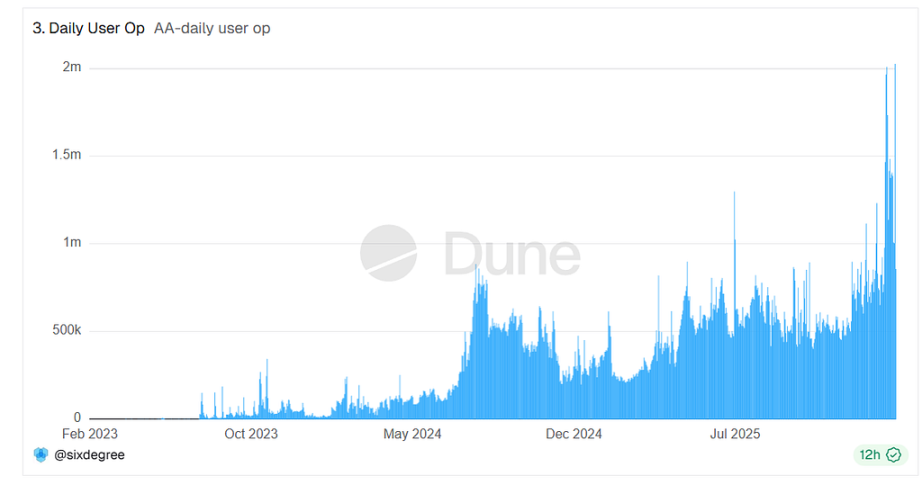
Source: https://dune.com/sixdegree/account-abstraction-overview
Meanwhile, the Ethereum client community continues to explore further improvements, such as EIP-7702, which would allow externally owned accounts to directly invoke certain smart account functions, further lowering the adoption threshold for account abstraction.
The Rise of Multi-Chain Ecosystems and Chain Abstraction
Beginning in 2020–2021, rising transaction fees on Ethereum accelerated the emergence of alternative Layer-1 blockchains and Layer-2 networks, leading to the rapid expansion of a multi-chain ecosystem. As users and assets became distributed across multiple chains, fragmentation emerged as a key challenge.
The downside of this multi-chain prosperity has been fragmented liquidity and higher user complexity. Assets do not flow freely across chains, and users must learn to navigate various cross-chain bridges and wallet tools, significantly increasing operational friction.
To address this issue, the industry gradually developed the concept of chain abstraction, which aims to hide multi-chain complexity at the protocol or infrastructure level. For example, some projects have introduced smart contracts that can be invoked across chains, or issued tokens that anchor assets across multiple networks simultaneously. This allows users to interact with cross-chain assets without needing to know which underlying chain they reside on.
In the stablecoin sector, this approach has given rise to chain-abstracted stablecoins. Under this model, users can deposit mainstream stablecoins on any supported chain and mint a globally unified stablecoin at a one-to-one ratio. This universal stablecoin can circulate freely across networks and be redeemed for native-chain assets when needed.
River is one of the pioneers of this model. It supports USDT on major chains such as Ethereum and TRON, USDD issued by TRON, and compliant U.S. dollar stablecoins such as USD1, using these as collateral to mint the universal stablecoin satUSD. Once minted, satUSD can circulate across multiple networks, effectively eliminating the need for traditional cross-chain stablecoin bridges. Holding satUSD is functionally equivalent to holding U.S. dollar liquidity across chains.
Beyond stablecoins, several well-known projects have entered the space of chain abstraction and cross-chain infrastructure. Protocols such as LayerZero and Axelar focus on cross-chain messaging, enabling smart contracts to be called directly across different networks. As Ethereum scalability improves and multi-chain coexistence becomes the norm, abstraction-layer infrastructure is expected to play an increasingly central role in the blockchain stack.
The Proposal and Evolution of the Intention Concept
During 2023–2024, projects such as Anoma formally introduced the concept of intent-based architecture for cross-chain and asynchronous transaction execution. This paradigm emphasizes that users need only specify the outcome they want to achieve, without specifying the execution path.
Account abstraction has since become a foundational component of the intent track, enhancing the flexibility of wallets and transaction workflows and enabling more expressive execution of user intent.
From 2024 to 2025, an increasing number of DeFi protocols, decentralized exchanges, and aggregators began incorporating intent mechanisms into product design to improve user experience. For example, solver bidding systems are used to execute user intents by identifying optimal execution routes, reducing operational complexity across transactions, cross-chain transfers, and asset management scenarios.
At present, intent-based systems remain in an early stage of development. However, application growth is already evident, particularly in areas such as transaction aggregation, automated investment execution tools, and cross-chain asset coordination. By significantly reducing on-chain operational complexity, the intent paradigm allows users to focus solely on desired outcomes rather than execution details, potentially accelerating the adoption of blockchain applications among a broader user base.
Source: https://blog.particle.network/chain-abstraction-vs-intents/
III. Representative Projects in the Abstraction and Intention Tracks
Account Abstraction: Smart Wallets and Permissionless Payments
- Safe ($SAFE) Safe is one of the earliest pioneers of account programmability. Prior to ERC-4337, which introduced multi-signature smart contract wallets supporting advanced features such as social recovery and transaction orchestration, the ecosystem had grown into the largest smart account ecosystem in Web3. The Safe team actively participates in developing account abstraction standards and plans to integrate new proposals, such as EIP-7702, into its ecosystem. At present, nearly all major DAO treasuries are managed through Safe wallets, and an increasing number of DeFi protocols support direct login and interaction via Safe. Given its early-mover advantage and deep ecosystem penetration, Safe is widely regarded as a core infrastructure asset within the account abstraction sector.
- Biconomy ($BICO) Biconomy initially focused on gas payment abstraction and cross-chain relay services, and has gradually evolved into a comprehensive account abstraction and chain abstraction solution for developers. Its SDK enables DApps to offer “one-click transactions,” allowing users to complete multi-step actions — such as token swaps and asset pledging — with a single signature. Gas fees can be sponsored by DApps or third parties, delivering a Web2-like user experience. Biconomy has also launched the Smart Account Nexus module, which enables large-scale deployment of ERC-4337 smart accounts. With its Modular Execution Layer expanding across multiple chains and supporting more complex “hypertransactions” (including cross-chain composite operations), Biconomy is positioned to further enhance user retention and long-term token utility.
- Particle Network ($PARTI) Particle Network takes a Web2-first approach to user experience by offering integrated password-free login and smart wallet solutions. Users can sign in using mobile phone numbers or email addresses, while Particle automatically creates ERC-4337 smart accounts in the background and manages private key sharding. This allows users to interact with blockchain applications without direct key management. Particle’s core innovation lies in its concept of a “universal account.” From the user’s perspective, there is a single unified account and balance. In practice, this maps to coordinated smart contract wallet instances deployed across multiple chains and managed through Particle’s underlying infrastructure. This effectively combines account and chain abstractions, enabling seamless multi-chain DApp use without concern for asset location or gas payments. Particle incentivizes network nodes through backend service fees and ecosystem tokens. However, its hosted infrastructure model raises questions around decentralization and security, making continued technological transparency and open-source development critical for building long-term user trust.
Chain Abstraction: Cross-Chain Liquidity and Unified Assets
- River ($RIVER) River enables users to deposit stablecoins across different chains and mint a uniformly priced, universal stablecoin, satUSD, thereby allowing liquidity to move seamlessly across networks. satUSD is an over-collateralized stablecoin with a protocol TVL of approximately $159 million, down from its peak of around $605 million in October 2025. The recent surge in RIVER’s token price has been driven in part by Sun Yuchen’s strategic investment announcement, as well as relatively low circulating supply and speculative market dynamics. As a result, short-term volatility risks remain elevated. Over the long term, River’s success depends on three core factors:
- Security: robust cross-chain asset anchoring and contract safety
- Network effects: expansion to more chains and application scenarios supporting satUSD
- Regulation: compliance across multi-chain stablecoin jurisdictions
- Integration with the TRON ecosystem provides River with a pathway for rapid expansion. If it can successfully integrate additional ecosystems, such as Ethereum and BSC, River may evolve into a cross-chain stablecoin hub, thereby expanding the value proposition of the RIVER token. Conversely, stalled growth or risk events could lead to sharp valuation corrections, necessitating close investor monitoring.
- ZetaChain ($ZETA) ZetaChain is a public blockchain designed for full-chain interoperability, often described as the “first global blockchain.” Its core feature is native cross-chain messaging and asset functionality built directly into the protocol. Smart contracts deployed on ZetaChain can directly control external assets on networks such as Bitcoin, Ethereum, Solana, and others. Developers can build omnichain applications that read and write state across multiple blockchains while executing logic on ZetaChain. For example, a DeFi operation initiated on ZetaChain can automatically interact with a DEX on Ethereum and a lending protocol on BSC, returning results to the user without reliance on third-party bridges. To mitigate decentralization risks, ZetaChain employs a DPoS-based multi-node architecture to verify external-chain assets. Its native token, ZETA, is used for gas fees and cross-chain consensus. ZetaChain represents a distinct approach to chain abstraction — using a new public chain as the coordination layer to natively fuse multiple blockchain ecosystems.
- LayerZero / Axelar LayerZero and Axelar represent core cross-chain communication infrastructure and play a crucial role in enabling chain abstraction. LayerZero provides a unified cross-chain messaging protocol that allows developers to build cross-chain applications more easily. Axelar offers a decentralized gateway network that enables asset and message transfers across chains and has also launched a cross-chain stablecoin, axlUSD, which is similar in design to satUSD. The two protocols approach abstraction from different angles: LayerZero focuses on the messaging layer, while Axelar emphasizes both messaging and asset transfer layers. As cross-chain interoperability becomes increasingly essential, the importance of such infrastructure continues to grow. However, cross-chain bridges remain one of the highest-risk areas in blockchain security. Although both projects have emphasized audits and security measures, any major incident in cross-chain infrastructure could have an outsized impact on token value. Investors should therefore closely monitor protocol reliability, security architecture, and audit transparency.
Intent: User Requests and Automated Execution
- Anoma ($XAN) Anoma is a Layer-1 blockchain designed around intent-centric architecture. Its goal is to function as a “decentralized operating system” in which users submit high-level on-chain requirements that the network automatically interprets and executes, without requiring users to specify execution steps. Rather than sending traditional transactions, users submit intents such as “exchange 50 Token A for Token B at a minimum rate of 1:100.” The network handles matching and execution through a three-layer architecture:
- Intent pool: collects user intents
- Solver layer: competes to construct valid execution plans
- Settlement layer: finalizes execution on-chain
- Namada, a parallel project within the Anoma ecosystem, provides zero-knowledge privacy by encrypting user-intent content and revealing results only upon completion. While conceptually powerful, Anoma faces significant technical complexity. Challenges such as solver game design, intent composability, and system efficiency remain open, making timelines and outcomes uncertain.
- CowSwap ($COW) CowSwap successfully applies intent-based thinking to Ethereum DEX trading and is among the most practical and well-supported implementations of the intent paradigm. Built on the Gnosis protocol, CowSwap allows users to submit a Request for Quote (RFQ) instead of executing a traditional swap transaction. For example, a user may declare: “exchange 100 DAI for at least 0.05 WBTC.” This intent is broadcast to professional market makers and solver bots, which compete to provide the best execution by aggregating DEX liquidity or matching complementary orders. If a valid execution plan meets the user’s conditions, the transaction is settled; if not, the order expires and the user pays no gas fees. This model offers several advantages:
- Batch matching: orders are processed in batches, often reducing slippage and gas costs
- MEV protection: intents are matched off-chain, preventing front-running
- Simplified UX: users only authorize execution once and only pay gas if execution succeeds
- CowSwap demonstrates how intent-based design can meaningfully improve user experience while preserving decentralization and economic efficiency.
IV. Risks and Challenges Facing the Abstraction and Intention Tracks
As emerging industry narratives, abstraction and intention demonstrate strong long-term potential. However, since the launch of early projects, overall performance has often fallen short of expectations. New paradigms typically experience volatility and friction as they transition from concept to large-scale adoption. A rational assessment of risks and challenges is therefore essential.
High Technical Complexity and Implementation Risk
Although standards for account abstraction have been established, real-world implementation remains challenging. Many decentralized applications still do not support smart account logins, and integrating ERC-4337 introduces additional development and operational complexity. For chain abstraction, achieving seamless connectivity across heterogeneous blockchains presents significant security and engineering challenges. As a result, security and system reliability underpin abstraction- and intent-based systems.
For example, River must ensure that satUSD remains fully collateralized at a 1:1 ratio and is protected against smart-contract and anchoring risks. Any loss of peg or asset backing would severely undermine user confidence. Similarly, intent-based networks must mitigate risks such as solver collusion, abuse of user intent, and the inherent trade-off between decentralization and execution efficiency. These technical challenges lack standardized solutions and require continuous iteration and protocol-level refinement.
Ecosystem Coordination and Standardization Challenges
The abstraction and intention landscape remains highly fragmented. In the short term, innovation is active; however, over the long term, the lack of unified standards may result in incompatible, siloed ecosystems. Beyond ERC-4337, non-EVM chains such as Aptos employ distinct account abstraction models. Some chain-abstraction solutions rely on cross-chain bridges, whereas others introduce new base-layer architectures, thereby complicating interoperability.
Within the intent track, different projects often define proprietary intent formats and execution protocols. Without cross-compatibility, this fragmentation limits network effects and reduces composability. To avoid isolated development paths, greater open-source collaboration and standard-setting efforts are required. Research institutions such as Paradigm have advocated for open intent pools and permissionless solver networks. Over time, industry coordination bodies — potentially analogous to the W3C — may emerge to align abstraction and intent standards across ecosystems.
Economic Design and Governance Risks
Abstraction and intent protocols introduce novel incentive structures and token economic models. If token distribution is poorly designed or governance mechanisms are insufficiently robust, risks such as price manipulation, governance capture, and misaligned incentives may arise.
In intent-based networks, solvers may prioritize strategies that maximize their own profits rather than outcomes that best serve users — for example, by extracting hidden MEV rather than returning surplus value. Designing incentive mechanisms that align solver behavior with user interests remains a core economic challenge.
Additionally, the levels of decentralization across these systems vary significantly. Many account abstraction wallets remain partially managed by development teams, numerous chain abstraction bridges rely on multi-signature control, and early-stage intent networks often operate with a limited number of active solvers. These centralized components represent latent systemic risks: once compromised or misused, they can directly threaten users’ assets and the protocol’s credibility.
Regulatory and Compliance Risks
Unified cross-chain stablecoins and intent-based execution networks — particularly those with abstract transaction details — are likely to draw heightened regulatory scrutiny. Stablecoins remain a focal point for global regulation, and projects operating across multiple jurisdictions must comply with local anti-money laundering and payment regulations.
For example, if River and similar protocols issue or circulate satUSD across different regions, they must address AML and compliance requirements applicable to each jurisdiction. Some abstraction projects aim to reduce friction in cross-border capital movement, which may conflict with existing financial controls and trigger regulatory concerns.
Intent-based systems, which may involve privacy-preserving transaction matching, also face compliance challenges related to money laundering prevention and illicit finance. Beyond technical safeguards, these projects may need to implement off-chain compliance frameworks such as KYT monitoring, address screening, and proactive engagement with regulators to ensure long-term viability.
V. Opportunities and Prospects: Opening a New Paradigm for Web3
Despite the challenges, the direction represented by abstraction and intention is widely regarded as a key driver of the large-scale adoption of blockchain technology. With continued technological iteration and ecosystem maturation, there is reason to remain cautiously optimistic about the long-term prospects of this field.
User Experience Transformation as the Core Breakthrough
From a user experience perspective, abstraction and intention are expected to work in tandem to elevate Web3 usability to an unprecedented level. Account abstraction improves wallet usability and security by preventing catastrophic loss scenarios caused by private-key mismanagement and by eliminating the need to constantly manage gas fees. Chain abstraction removes ecosystem barriers, freeing users from concerns such as which chain their assets reside on or which Layer 2 a given application belongs to. Intent-based interaction further shifts the paradigm by allowing users to simply express desired outcomes, while systems automatically handle execution.
If these technologies are maturely integrated, the experience of using blockchain applications may approach — or even surpass — that of traditional internet services. Users would only need to register an account, select a service, and interact seamlessly across multiple underlying blockchains. Such an experience could fundamentally remove the key obstacles to mass adoption and enable the next wave of tens or even hundreds of millions of users to enter the Web3 ecosystem.
Unlocking New Application Design Space
From the perspective of application innovation, abstraction and intention significantly expand the design space available to developers. As cross-chain and complex interactions become simpler and more efficient, developers can fully unlock creativity and build application scenarios that were previously impractical or impossible.
For example, through chain abstraction, DeFi applications can aggregate liquidity across multiple chains to provide users with optimal yields without exposing the underlying asset-routing process. When combined with intent-based execution, financial protocols enable users to post high-level instructions — such as “automatically allocate funds to the highest-yield pools” — that are then optimized and executed by intelligent agents.
These strategies, which previously required advanced user expertise or manual execution, become accessible through abstraction and intent infrastructure. Beyond DeFi, intent-driven design shows strong potential in areas such as NFTs, gaming, and social applications. NFT marketplaces can enable users to submit purchase intentions, while platforms automatically determine optimal pricing. In blockchain gaming, players can express complex in-game objectives, such as defeating a boss or exchanging rewards, which are executed automatically through coordinated smart contracts.
It is foreseeable that abstraction and intention will give rise to a new generation of decentralized applications, opening a broad landscape of previously unexplored opportunities.
3. Alignment with Long-Term Industry Trends
From an industry perspective, abstraction and intention closely align with the ongoing shift toward multi-chain architectures and user experience prioritization. They are increasingly viewed as core pillars of the next Web3 development cycle.
The Ethereum Foundation and multiple Layer-2 teams have explicitly identified user-experience improvement as a strategic research direction. Account abstraction standards continue to mature, while Layer 2 ecosystems actively explore integration between account abstraction and intent-based execution. At the same time, non-EVM public chains such as Sui and Aptos are experimenting with abstraction and intent mechanisms, leveraging languages like Move to enable customized account logic and authentication flows.
Beyond native Web3 players, traditional technology and financial institutions are also closely monitoring these trends. Payment networks such as Visa and Mastercard are researching account abstraction for automated payments and programmable settlement, while decentralized social applications are increasingly exploring abstraction-driven onboarding models.
Taken together, abstraction and intention appear to be approaching a phase of accumulation. As underlying technologies mature and ideas converge, this convergence may trigger a “sudden satisfaction” effect — where improved user experience catalyzes rapid user growth and application expansion at scale.
Conclusion
In today’s blockchain landscape, technological innovation continues to accelerate. The rise of abstraction and intent reflects the industry’s growing demand for better user experience and stronger application connectivity. From chain-abstracted stablecoins such as River to intent-centric public chains like Anoma, these projects are reshaping the foundational logic of on-chain interaction.
Throughout this article, we have examined the innovations that drive these paradigms and assessed the risks embedded in their technical, economic, and regulatory structures. Looking ahead, abstraction and intent are likely to gain further momentum and gradually integrate into mainstream blockchain applications. As the vision of seamless cross-chain interaction and transaction freedom becomes reality, blockchain’s value proposition will extend to a much broader audience.
About Us
Hotcoin Research, the core research and investment arm of Hotcoin Exchange, is dedicated to turning professional crypto analysis into actionable strategies. Our three-pillar framework — trend analysis, value discovery, and real-time tracking — combines deep research, multi-angle project evaluation, and continuous market monitoring.
Through our Weekly Insights and In-depth Research Reports, we analyze market dynamics and highlight emerging opportunities. With Hotcoin Selects, our exclusive dual-screening process powered by both AI and human expertise, we help identify high-potential assets while minimizing trial-and-error costs.
We also engage with the community through weekly livestreams, decoding market hot topics, and forecasting key trends. Our goal is to empower investors of all levels to navigate cycles with confidence and capture long-term value on Web3.
Risk Disclaimer
The cryptocurrency market is highly volatile, and all investments carry inherent risks. We strongly encourage investors to remain informed, assess risks thoroughly, and adhere to strict risk management practices to protect their assets.
Connect with Us
Website: https://lite.hotcoingex.cc/r/Hotcoinresearch
X: x.com/HotcoinAcademy
Email: labs@hotcoin.com
【免责声明】市场有风险,投资需谨慎。本文不构成投资建议,用户应考虑本文中的任何意见、观点或结论是否符合其特定状况。据此投资,责任自负。